BD Team 2030: How flexible teams and technology will drive growth
Overview
On Wednesday 4th November, we brought together senior BD and marketing leaders from professional firms.
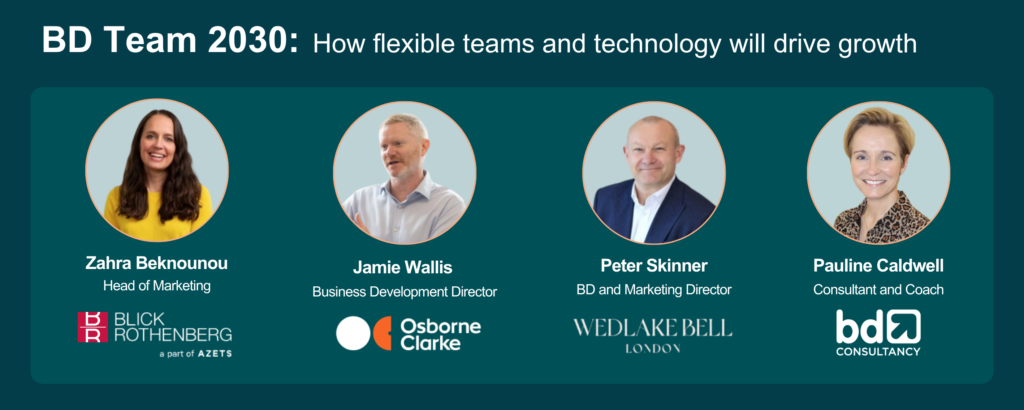
Together, the panel brought perspectives from accountancy, law and management consultancy, creating a broad discussion on how firms can build growth-focused teams fit for the future.
While AI and technology featured heavily throughout, the conversation extended far beyond tools and platforms. Discussions centred on leadership, team design, culture and the changing skills required within modern growth teams. There was broad agreement that BD and marketing functions are moving away from delivery-focused support roles towards strategic growth partners, expected to provide commercial insight and influence leadership decisions.
Many firms observed that responsibility for AI adoption has naturally gravitated towards BD and marketing teams, given their close connection to data, CRM systems and client insights.
However, some of the most interesting insights were the lessons that emerged unexpectedly during the discussion.
Five unexpected lessons from the event
While AI and technology were expected to dominate the conversation, some of the most interesting insights came from rather different areas. Five themes stood out, challenging some common assumptions about how professional services firms will need to evolve.
1. Hybrid working is still a surprisingly divisive issue
Despite years of adapting to new ways of working, consensus on the right balance between office and home working remains absent.
Some leaders argued that flexibility is essential to attract and retain talent, particularly among younger professionals. Others shared internal data suggesting that office-based teams benefit from stronger collaboration, productivity and opportunities for junior colleagues to learn through working alongside more experienced staff.
What was surprising was how strongly opinions differed. The debate highlighted that hybrid working remains an unresolved question for many firms, with culture, productivity, talent development and employee expectations all competing for attention.
2. Flexible expertise is becoming an alternative to permanent headcount
One of the strongest themes to emerge was the growing appetite for consultants, interim support and fractional specialists.
Several attendees shared examples of firms that struggled to secure permanent headcount but successfully brought in external expertise to accelerate projects, fill capability gaps and deliver strategic change.
Rathrt than automatically recruiting to build every capability in-house, firms are increasingly considering what expertise they need, when they need it and whether it needs to be permanent. This creates opportunities for more agile team structures, allowing firms to scale resources up and down while managing the cost and risk of additional headcount.
3. AI hasn’t quite lived up to the hype – yet
There was no shortage of enthusiasm for AI, and plenty of examples of where it is already making a difference. From research and campaign reporting to lead qualification and data enrichment, some teams are seeing genuine improvements in efficiency and productivity.
However, the more unexpected finding was how few firms felt they had achieved transformational change. Most are still experimenting with tools, testing workflows and identifying practical applications, rather than fundamentally changing how their teams operate or deliver services.
The gap between the excitement surrounding AI and the reality of its implementation was a recurring theme. Firms are experimenting with automations and agents, but few have fundamentally changed their operating models or service delivery as a result.
4. The ability to challenge leadership could be key to defining growth
An important thread running throughout the discussion was the relationship between BD and marketing teams and their firm’s senior leadership.
There was recognition that the most effective growth teams need to do more than respond to requests and deliver activity. They must be confident enough to challenge partners, question existing approaches and use client insight, financial data and commercial evidence to influence decisions.
But this isn’t simply about individual confidence. It also requires the right culture. Partners and senior management must champion change and create an environment where BD and marketing professionals feel confident challenging existing approaches and influencing decisions, with the trust and permission to have challenging conversations and make recommendations. Without that environment, even the most commercially capable teams may struggle to influence meaningful change.
5. AI is affecting different seniorities differently
While younger professionals may be quicker to adopt new tools and experiment with different applications, experienced professionals bring something equally important: commercial judgement, contextual understanding and the ability to recognise when an AI-generated answer is inaccurate, incomplete or inappropriate.
As AI makes information and content easier to produce, the ability to interpret, question and apply it effectively is essential for a firm’s reputation and perceived professionalism. The resounding message from the discussion was that despite repeated predictions over the last 24 months that AI will diminish the need for traditional workforce, BD and marketing leaders see its role as one of transformation rather than replacement. While technology will continue to redefine how teams operate, the consensus was that emotional intelligence and relationship management will remain at the heart of effective growth teams.
Looking Ahead
The firms most likely to succeed in the future will be those that combine the right technology with the right people, skills and culture. Placing the right people in senior roles is more important than ever, but the ability to place senior people on a flexible basis will set future-focused firms apart from their peers and competitors. While AI will undoubtedly reshape how work is delivered, leadership and adaptability will remain the qualities that differentiate the highest-performing growth teams.
As firms consider what this means for their own BD and marketing functions, now is the time to reflect on whether their teams and strategies are ready for the future.
If you’d like to discuss how your BD and marketing team can evolve to meet the challenges and opportunities ahead, we’d love to hear from you.
Get in touch with Alice at alice@thebdconsultancy.com.